ClickFunnels Vs. Leadpages: Which Is Better For Landing Pages?

Struggling to decide between ClickFunnels and Leadpages for your landing pages? ClickFunnels focuses on full sales funnels, while Leadpages shines at creating simple, high-converting landing pages.
This post will walk you through the key differences to help you choose what fits your needs best. Keep reading to find the right tool for you!
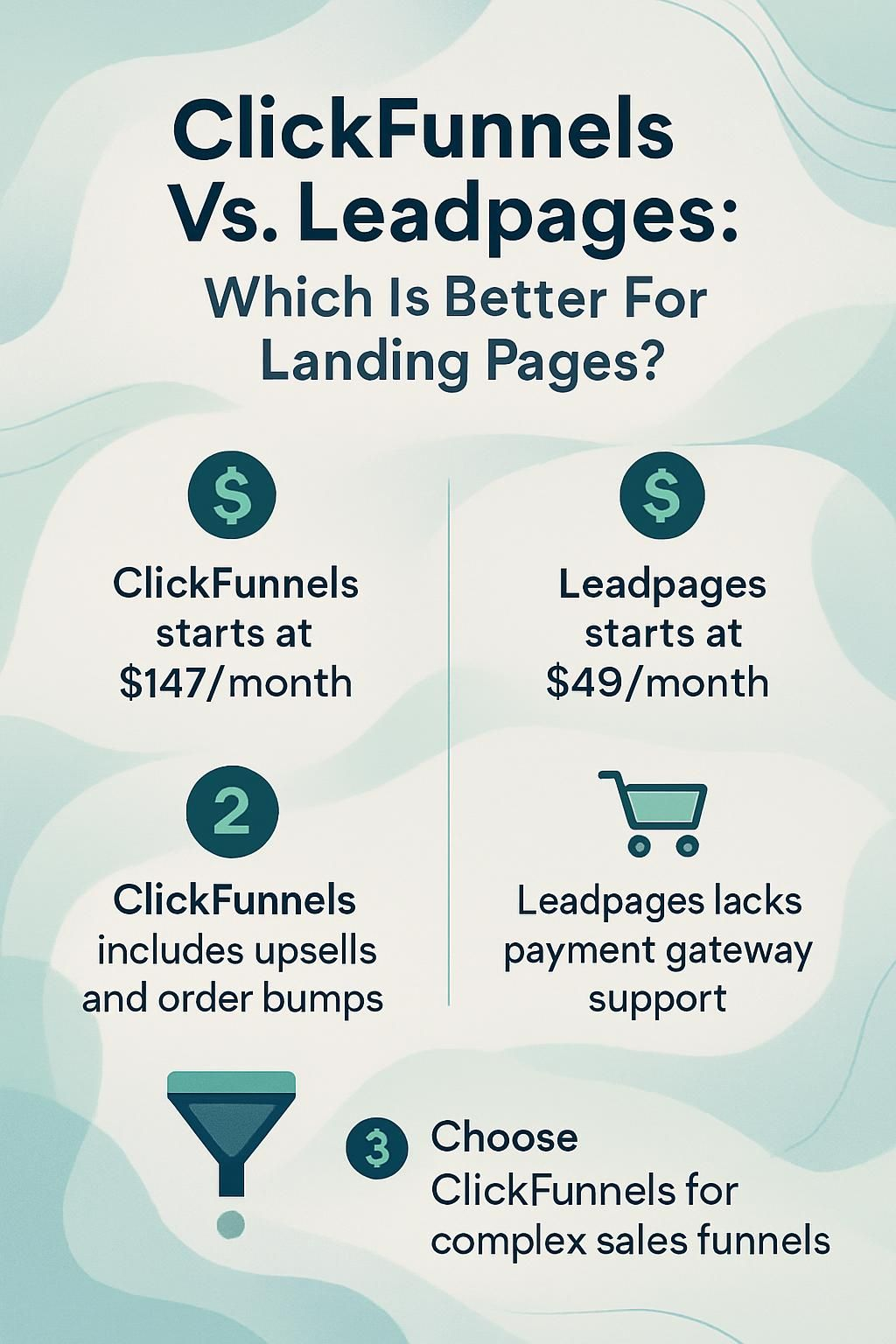
Overview: ClickFunnels vs. Leadpages

ClickFunnels and Leadpages help you create landing pages, but their approaches differ. Each tool suits specific goals and users based on its features.
Key focus areas of both platforms
ClickFunnels focuses on creating full sales funnels. It includes tools like upsells, automated email marketing, and order bumps for your business strategy. This makes it great for advanced sales processes and conversion optimization.
You can also build webinar funnels or membership sites with ease.
Leadpages is designed for creating high-converting landing pages. Its key features include a drag-and-drop editor, alert bars, opt-in forms, and countdown timers to boost lead generation efforts.
It works well for small businesses looking to save on budgets while still using effective marketing tools.
Choose ClickFunnels if you need complex funnel systems. Choose Leadpages for simple but effective landing pages.
Target audiences for each tool
ClickFunnels works best for businesses needing full sales funnels or advanced tools like email marketing, order bumps, and one-click upsells. It fits companies involved in complex sales sequences or digital marketing strategies.
If you manage membership sites, webinar funnels, or gated content, this tool can streamline your efforts.
Leadpages appeals to small businesses focused on simple lead generation and landing page optimization. Its drag-and-drop builder and user-friendly interface make it great for people with limited technical skills or budgets.
It’s ideal if you need quick landing pages with opt-in forms and countdown timers without paying for extra features.
Next is “Ease of Use.
Ease of Use
Both platforms aim to simplify your workflow with user-friendly tools. Their drag-and-drop builders make creating landing pages fast and easy for all skill levels.
Intuitive interface comparison
ClickFunnels has a more complex interface because of its advanced features like sales funnels and order bumps. You may find it harder to use if you’re new or prefer simple tools.
Its drag-and-drop builder works well but might take time to learn fully.
Leadpages keeps things simpler, focusing on easy lead generation. Its drag-and-drop editor feels smooth and is beginner-friendly. If quick setup matters most, this platform makes sense for you.
As a bonus, the streamlined design saves time without sacrificing quality.
Simplicity drives faster results in landing page creation.
Learning curve for beginners
Understanding ClickFunnels can take time. Its advanced tools, like one-click upsells and automated email features, make the platform tricky for new users. Beginners might feel overwhelmed by its setup process and full-funnel system.
Leadpages is easier to use. It focuses on making clean, simple landing pages quickly. The drag-and-drop builder helps you customize without stress. If you’re starting with limited resources or technical skills, Leadpages is more beginner-friendly.
Landing Page Builder Features
Both tools offer simple drag-and-drop builders for creating landing pages. You’ll find plenty of templates and ways to tailor them to match your style.
Customization options
ClickFunnels offers a drag-and-drop builder that makes customization simple. You can adjust colors, fonts, and layouts with ease. It also allows for custom domains and advanced tweaks like one-click upsells or order bumps.
These tools help craft unique sales funnels customized to your needs.
Leadpages focuses on simplicity while still giving you control. Its templates are flexible, letting you change images, text, and opt-in forms quickly. You can add alert bars or countdown timers for better conversion optimization without extra hassle.
Template variety and flexibility
Both platforms offer many templates for landing pages. ClickFunnels provides funnel templates focused on sales funnels, order bumps, and upsells. These aim to boost conversion rate and revenue.
Their drag-and-drop builder makes editing easy.
Leadpages offers clean designs great for lead generation. You get opt-in forms, alert bars, and countdown timers ready to go. Templates work well across mobile marketing tools like tablets or phones.
Custom domains are also supported for a branded feel.
Conversion Tools
ClickFunnels offers smart tools to boost sales funnels and increase earnings per click. Leadpages keeps things simple for easy lead generation through opt-in forms and alert bars.
ClickFunnels: Advanced funnel features
You can create complete sales funnels with ClickFunnels. It supports upsells, downsells, and one-click upsells to boost revenue. You also get tools like order bumps and automated email sequences for better conversion optimization.
The platform includes advanced funnel templates to save time. Use countdown timers and exit intent pop-ups to increase urgency. Integrate it with CRM systems or email marketing tools for smooth customer journeys.
For complex strategies, ClickFunnels helps build webinar funnels, membership sites, and gated content easily.
Leadpages: Simplicity in lead generation
Leadpages focuses on creating landing pages for lead generation. Its drag-and-drop builder helps you design and publish pages quickly without coding. You can use pre-designed templates to save time and fit your style.
The platform is budget-friendly, making it great for small businesses or startups. It simplifies lead generation with opt-in forms, alert bars, and pop-ups. If you value ease over complex features like one-click upsells or membership sites, Leadpages works best for you.
Integrations
Both platforms connect well with popular tools like email marketing services and CRM systems. You can also use third-party apps for extra flexibility.
Native integrations comparison
ClickFunnels and Leadpages, though similar, differ in their integration capabilities. Here’s how their native integrations stack up side by side:
| Integration Area | ClickFunnels | Leadpages |
|---|---|---|
| Email Marketing | Integrates with Mailchimp, ActiveCampaign, AWeber | Supports Mailchimp, HubSpot, ConvertKit |
| Payment Gateways | Offers Stripe, PayPal, Authorize.net | No payment gateways built-in |
| CRM Tools | Connects to Salesforce, HubSpot | Integrates with Salesforce, Zoho CRM |
| Webinars | Compatible with WebinarJam, Zoom | Offers GoToWebinar, WebinarJam |
| eCommerce | Compatible with Shopify, WooCommerce | Limited eCommerce support |
| Analytics | Supports Google Analytics, Facebook Pixel | Allows Google Analytics, Facebook Pixel |
ClickFunnels supports more advanced payment and eCommerce tools. Leadpages works well for basic integrations. Both have easy email and webinar options.
Zapier compatibility
Zapier works with both Leadpages and ClickFunnels. It helps you connect these tools to other apps like email marketing platforms or CRM tools. You can automate tasks such as syncing leads to your inbox or setting up email campaigns.
Create workflows easily without coding. For example, when someone fills out a form on your landing page, Zapier can send their details directly to Google Analytics or your preferred CRM.
This saves time and boosts efficiency for small businesses seeking smarter automation options.
Pricing
Pricing can be a key factor in your decision. Each platform offers its own plans and features to match your budget and goals.
Leadpages pricing plans
Leadpages offers simple and budget-friendly plans. The Standard Plan costs $49 per month, while the Pro Plan is priced at $99 monthly. If you opt for yearly billing, you get discounts on both.
These plans provide access to their drag-and-drop builder, landing page templates, and basic lead generation tools.
The Advanced Plan includes features like advanced A/B testing tools and priority customer support. You can also unlock custom domains and integrations with CRM tools or email marketing platforms.
This flexibility makes Leadpages a great choice for small businesses focusing on affordable options with strong conversion optimization tools.
Next up: ClickFunnels pricing plans…
ClickFunnels pricing plans
ClickFunnels offers two main pricing plans: the Basic Plan at $147 per month and the Pro Plan at $197 per month. The Basic Plan includes funnel templates, drag-and-drop builder tools, and one domain hosting.
It works well for small businesses or beginners starting with sales funnels.
The Pro Plan adds features like unlimited funnels, more custom domains, and advanced conversion tools such as one-click upsells and membership sites. This plan supports teams needing CRM tools or detailed analytics to boost their marketing strategy.
Both plans provide 24/7 customer support and integration options for email marketing platforms or payment gateways.
Analytics and Reporting
Both platforms help track conversion rates and offer tools for optimization. Clear dashboards make it easy to understand your landing page performance.
Tracking tools available on each platform
ClickFunnels offers tools for tracking user behavior across sales funnels. You can monitor touchpoints, measure conversion rate, and track performance through dashboards. It also supports integration with Google Analytics for deeper insights.
Leadpages focuses on simpler metrics like opt-in form submissions and conversion tracking. It works well with cookies to help you analyze visitor actions. You can pair it with other marketing tools like Facebook Pixel or Google Ads to improve campaign results.
Conversion rate optimization features
Both platforms excel in boosting conversions but take different paths. With advanced funnel features, like upsells and downsells, you can guide users through sales funnels with ClickFunnels for higher revenue.
Countdown timers and one-click upsells also play a key role in driving decisions fast.
Leadpages focuses on simple tools to grab leads quickly. Pop-ups, alert bars, and opt-in forms help engage visitors without confusion. Split testing allows you to test which design works best.
This keeps your landing pages effective at converting users into customers or subscribers.
Customer Support and Resources

Both platforms offer help through guides and tutorials. You can also access support teams for troubleshooting technical issues.
Support availability
ClickFunnels offers 24/7 customer support through live chat, email, and ticket systems. Its knowledge base is also packed with helpful guides to troubleshoot issues fast.
Leadpages provides email and chat support during business hours. It has an extensive library of tutorials and articles for self-help. Both platforms ensure users feel equipped to resolve challenges efficiently.
Educational materials and community resources
Both platforms offer helpful guides and tutorials. You can find eBooks, blogs, and webinars to learn faster.
ClickFunnels has a vibrant community with forums and Facebook groups for advice. Leadpages also offers live chat events and workshops to improve your skills quickly.
Use Cases: Which Platform is Best for You?
Pick ClickFunnels if you want advanced sales funnels or order bumps for boosting revenue. Choose Leadpages if your focus is simple lead generation and cost-effective landing pages.
When to choose ClickFunnels
Choose ClickFunnels if you need a full sales funnel system. This platform works well for businesses that handle complex sales processes like upsells, downsells, and automated email sequences.
It includes tools like one-click upsells, order bumps, and funnel templates.
Go with it for advanced marketing funnels or webinar funnels. Use this tool to build membership sites and integrate checkout forms seamlessly. ClickFunnels is ideal if your focus is on complete conversion optimization rather than just creating landing pages.
When to choose Leadpages
Pick Leadpages if you need quick and simple landing pages. It works well for lead generation without complex sales funnels. The drag-and-drop builder helps you create pages fast, even with no design skills.
For basic projects or tight budgets, it’s a smart choice. Its templates are easy to edit, so you can customize them quickly. Use it to make opt-in forms, alert bars, or gated content while saving money.
Conclusion
Choosing between ClickFunnels and Leadpages depends on your needs. If you want a complete sales funnel with advanced tools, ClickFunnels is better for you. If you’re focused on quick, cost-effective landing pages for lead generation, go with Leadpages.
Both are great but serve different goals for online growth.
Disclosure: I am an independent ClickFunnels Affiliate, not an employee. I receive referral payments from ClickFunnels. The opinions expressed here are my own and are not official statements of ClickFunnels or its parent company, Etison LLC.